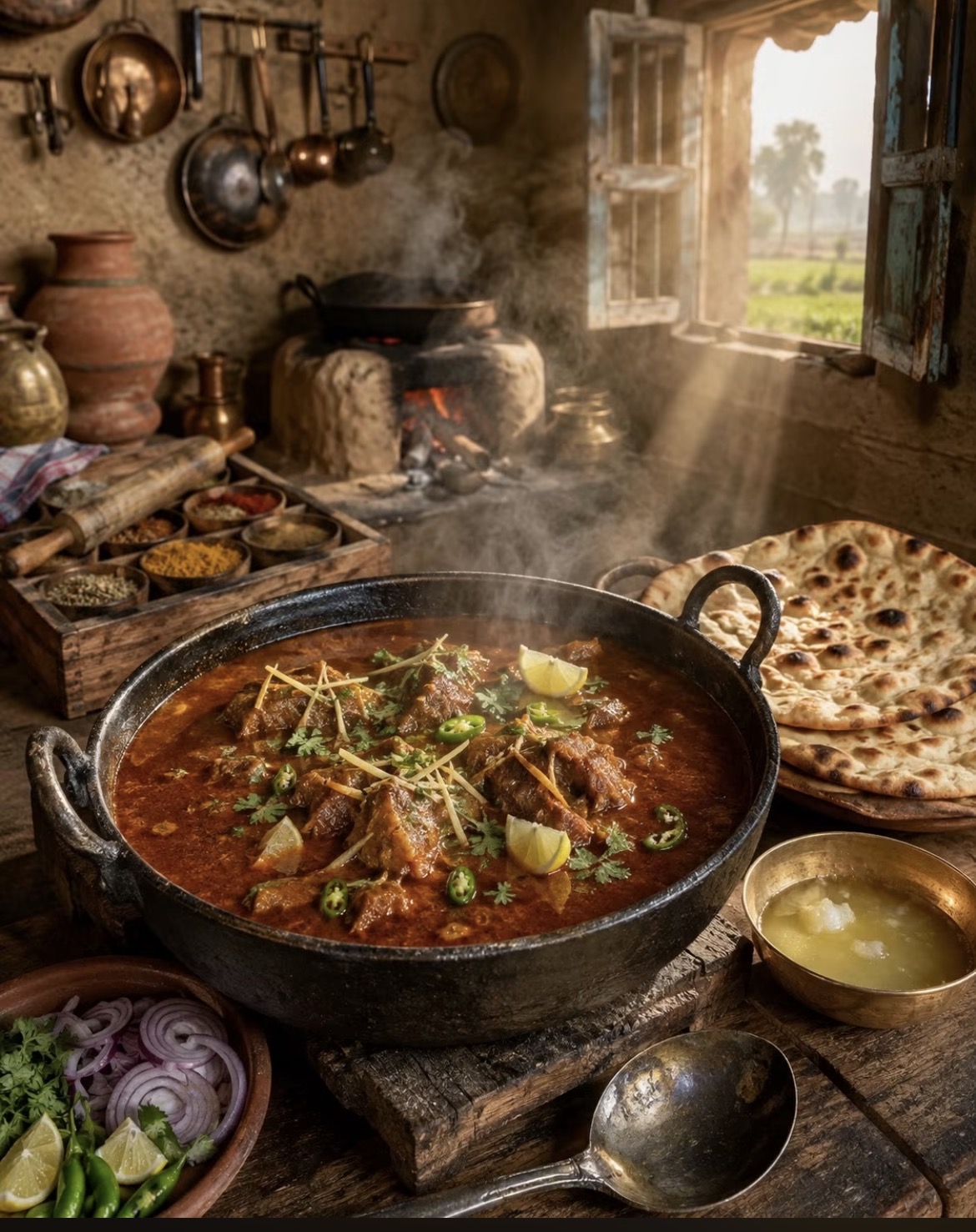
There are meals, and then there are experiences. The image above encapsulates the latter. It is a portal to a rural South Asian kitchen, likely somewhere in the Punjab region or the foothills of the Himalayas, where cooking is not a hurried chore but a sensory ritual.
Look closely at the steam—thick, fragrant, and curling upward into the golden dust motes of a late afternoon sun. That steam carries the scent of caramelized onions, slow-cooked lamb, and the sharp, earthy punch of freshly ground garam masala.
This is not a dish prepared in a pristine, stainless-steel kitchen with a gas burner. This is a dish born on a chulha (mud stove), fed by dried wood and twigs. The heavy kadai (cast-iron wok) sits on a rough wooden block, ensuring the heat is distributed evenly, allowing the meat to braise until it is so tender it falls apart at the gentlest nudge of a spoon.
The rustic plating is a testament to the philosophy of rural cooking: simple ingredients, massive flavor. The meat is bathed in a rich, crimson-red gravy, not from synthetic food coloring, but from a careful blend of Kashmiri red chilies, tomatoes, and the rendering of mutton fat. The final flourish of ginger juliennes (adrak) and fresh green chilies adds a sharp, spicy brightness that cuts through the heavy, unctuous sauce. It is served with warm, blistered tandoori roti and a simple side of pickled onions and lemon—all that is needed to complete the meal.
This dish is more than food; it is hospitality. It is the warmth of a grandmother’s kitchen, the reward after a long day in the fields, and the undeniable comfort of eating with your hands.
Full Recipe: Village-Style Mutton Karahi (Spiced Mutton Curry)
Prep time: 25 minutes | Cook time: 1 hour 15 minutes | Serves: 4-6
Ingredients
For the Meat & Marinade:
· 2 lbs (approx. 900g) Mutton (bone-in, preferably shoulder or leg): Cut into 2-inch chunks. Note: Bone-in meat is essential for the rich flavor shown in the photo.
· 1 cup Plain Yogurt: Whisked until smooth.
· 1 tbsp Ginger-Garlic Paste
· 1 tsp Salt
· 1 tsp Turmeric Powder
For the Gravy:
· 4 tbsp Ghee (or Mustard Oil for authenticity): Ghee gives that golden, nutty flavor.
· 2 large Onions: Finely chopped.
· 2 tbsp Ginger-Garlic Paste
· 2 large Tomatoes: Pureed or finely grated.
· 1 tbsp Kashmiri Red Chili Powder: Crucial for that vibrant red color without extreme heat.
· 1 tbsp Coriander Powder
· 1 tsp Cumin Powder
· 1 tsp Garam Masala Powder
· 2-3 Green Chilies: Slit lengthwise.
For the Garnish (As seen in the photo):
· Fresh Ginger: Julienned (cut into thin matchsticks).
· Fresh Green Chilies: Chopped.
· Fresh Cilantro (Coriander leaves): Roughly chopped.
· Lemon Wedges and Sliced Red Onion.
Instructions
Step 1: Marinate the Mutton
In a large bowl, combine the mutton chunks, yogurt, 1 tbsp ginger-garlic paste, salt, and turmeric. Mix well, ensuring every piece of meat is coated. Cover and let it marinate for at least 1 hour (overnight in the fridge is even better).
Step 2: The Base (The “Bhuna”)
Heat the ghee in a heavy-bottomed kadai (or Dutch oven) over medium heat. Add the chopped onions and sauté until they turn deep golden brown (about 10 minutes). Do not rush this step; the color of the onions determines the depth of the gravy.
Add the remaining ginger-garlic paste and cook for 1 minute until the raw smell disappears.
Step 3: Cook the Masala
Turn the heat down to medium-low. Add the Kashmiri red chili powder, coriander powder, and cumin powder. Fry this spice mixture (masala) with the onions for about 2 minutes, stirring constantly to prevent burning. Add a splash of water if it begins to stick.
Add the pureed tomatoes and cook until the ghee separates from the masala and floats on top (about 8-10 minutes). This is the sign that the base is perfectly cooked.
Step 4: Add the Meat & Simmer
Add the marinated mutton to the kadai. Turn the heat to high and stir vigorously for 4-5 minutes, “bhunaoing” the meat until it seals in the juices and changes color.
Step 5: The Slow Cook
Add 2 cups of hot water and bring the curry to a rolling boil. Once boiling, reduce the heat to the lowest possible setting, cover the pot, and let it simmer for 45 minutes to 1 hour. Stir occasionally.
The meat is ready when it is tender and easily separates from the bone. If you have a pressure cooker, this step takes 15 minutes after the whistle.
Step 6: Finishing Touches
Once the meat is tender, remove the lid. If the gravy is too thin, increase the heat and cook uncovered until it thickens to your liking. If it is too thick, add a little more hot water.
Add the slit green chilies, the Garam Masala, and a pinch of salt if needed. Stir gently. Turn off the heat.
Step 7: Garnish & Serve
Transfer the curry to a serving dish (as shown in the image). Generously top with the fresh julienned ginger, chopped green chilies, and fresh cilantro.
Serve piping hot with freshly made Roti, Naan, or plain steamed rice, alongside a side salad of red onions, lemon wedges, and perhaps a bowl of ghee for dipping the bread.
Pro Tip: The true flavor of this dish comes from the “smoking” technique. In a traditional kitchen, they often place a small piece of charcoal in a bowl, heat it until red hot, place it inside the finished curry, and pour a drop of ghee over it, instantly covering it to trap the smoky aroma for 2 minutes. This replicates the flavor of the village fire shown in your photo